
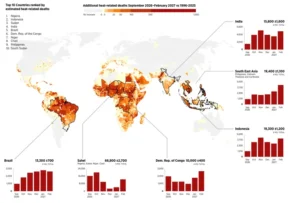
A powerful Super El Niño event could result in more than 857,000 additional heat-related deaths globally by March 2027, with Nigeria and India projected to record the highest numbers, according to estimates by the Climate Impact Lab.
The research identifies Nigeria as the country facing the greatest potential impact, with an estimated 56,100 additional deaths, narrowly ahead of India, which could record approximately 55,200.
Indonesia ranks third with a projected 29,300 deaths, followed by Brazil with 19,500 and Sudan with 14,700.
The Climate Impact Lab’s El Niño Heat Mortality Tracker estimates that approximately 372,900 additional heat-related deaths could occur worldwide between October 2026 and March 2027 as unusually high temperatures continue to affect different regions.
The latest figures form part of a broader projection of 857,400 additional deaths between June 2026, when the current El Niño event started, and March 2027.
According to the researchers, the potential impact is expected to be particularly severe in countries across the Global South, especially in Africa and Asia, where exposure to extreme temperatures and limited access to cooling facilities increase vulnerability.
Ghana is also among the countries facing significant risks, with an estimated 7,000 additional heat-related deaths projected during the six-month period. This places the country 12th on the list of 50 nations included in the assessment.
Other African countries facing considerable risks include the Democratic Republic of Congo and Chad, with 11,300 projected deaths each, Niger with 8,400, Burkina Faso with 6,900, South Sudan with 6,500 and Ethiopia with 6,000.
Why have the projections increased?
The latest estimates represent a significant increase from the Climate Impact Lab’s September 2026 assessment, which projected approximately 451,000 additional heat-related deaths between June 2026 and February 2027.
Researchers attributed the rise to an extension of the forecast period to March 2027 and the replacement of earlier temperature predictions for August and September with actual observations.
Both months recorded higher temperatures than initially anticipated. August was the hottest on record for the month, while September ranked as the second warmest.
Understanding the Super El Niño phenomenon
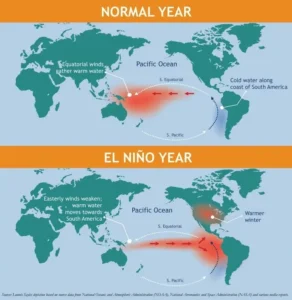
El Niño is a naturally occurring climate pattern characterised by unusually warm sea surface temperatures in the central and eastern parts of the equatorial Pacific Ocean.
The phenomenon influences atmospheric circulation and can alter normal weather conditions, resulting in higher temperatures and changes in rainfall patterns across several parts of the world.
The ongoing event has been described as a Super El Niño because of its intensity. Its effects include extended periods of extreme heat, which can increase the likelihood of heat-related illnesses and fatalities.
Prolonged exposure to excessive temperatures can cause dehydration, heat exhaustion and potentially fatal heatstroke. It can also worsen existing heart and respiratory conditions.
Older people, young children and individuals with underlying medical conditions are particularly vulnerable. Outdoor workers and people living in poorly ventilated homes or communities with limited access to clean drinking water and cooling facilities also face heightened risks.
How the Climate Impact Lab arrived at its estimates
The Climate Impact Lab developed its projections using research into the relationship between temperature changes and mortality, while considering variations in local climates, population vulnerability and communities’ ability to adapt to extreme heat.
For months that have already passed, the researchers rely on temperature observations from the ERA5 global reanalysis dataset.
Predictions for upcoming months are based on the European Centre for Medium-Range Weather Forecasts’ SEAS5 seasonal forecasting system.
The organisation emphasises that the figures represent estimated additional deaths linked to temperature changes compared with historical averages. They are not confirmed fatalities or estimates of all deaths expected during the period.
Measures governments can take to reduce heat-related deaths
The researchers believe the projections can help governments, humanitarian agencies and policymakers identify vulnerable populations and prioritise measures to minimise the effects of extreme heat.
Recommended interventions include introducing effective heat-warning systems, improving access to safe drinking water, establishing public cooling centres and strengthening healthcare facilities to manage heat-related emergencies.

Governments are also encouraged to introduce stronger workplace protections for people working outdoors. These could include providing shaded resting areas, ensuring access to drinking water and allowing regular breaks during periods of extreme temperatures.
The Climate Impact Lab’s El Niño Heat Mortality Tracker will be updated monthly until the current El Niño event ends, providing decision-makers with updated information to guide emergency preparations and public health interventions.
Although the projections could change as new temperature observations and forecasts become available, the findings highlight the potential health consequences of extreme heat and the importance of early intervention.
Top 50 Countries Projected to Record Additional Heat-Related Deaths Between October 2026 and March 2027
| Country | Projected additional deaths |
|---|---|
| Nigeria | 56,100 |
| India | 55,200 |
| Indonesia | 29,300 |
| Brazil | 19,500 |
| Sudan | 14,700 |
| Thailand | 12,200 |
| DR Congo | 11,300 |
| Chad | 11,300 |
| Philippines | 11,100 |
| Niger | 8,400 |
| Vietnam | 8,300 |
| Ghana | 7,000 |
| Burkina Faso | 6,900 |
| Bangladesh | 6,700 |
| Mali | 6,700 |
| South Sudan | 6,500 |
| Ethiopia | 6,000 |
| Cameroon | 5,900 |
| Benin | 5,200 |
| Cambodia | 4,500 |
| Mozambique | 4,500 |
| Uganda | 4,200 |
| Côte d’Ivoire | 4,000 |
| Tanzania | 4,000 |
| Togo | 3,600 |
| Venezuela | 3,600 |
| Somalia | 3,400 |
| Colombia | 3,300 |
| Myanmar | 3,200 |
| Kenya | 2,800 |
| Ecuador | 2,500 |
| Peru | 2,300 |
| Angola | 2,200 |
| Guinea | 2,100 |
| South Africa | 1,900 |
| Madagascar | 1,800 |
| Malawi | 1,700 |
| Malaysia | 1,700 |
| Senegal | 1,700 |
| United States | 1,700 |
| Zambia | 1,600 |
| Central African Republic | 1,500 |
| Sri Lanka | 1,400 |
| Mexico | 1,300 |
| Haiti | 1,100 |
| Sierra Leone | 1,100 |
| Zimbabwe | 1,100 |
| Nicaragua | 890 |
| Yemen | 880 |
| Pakistan | 820 |