
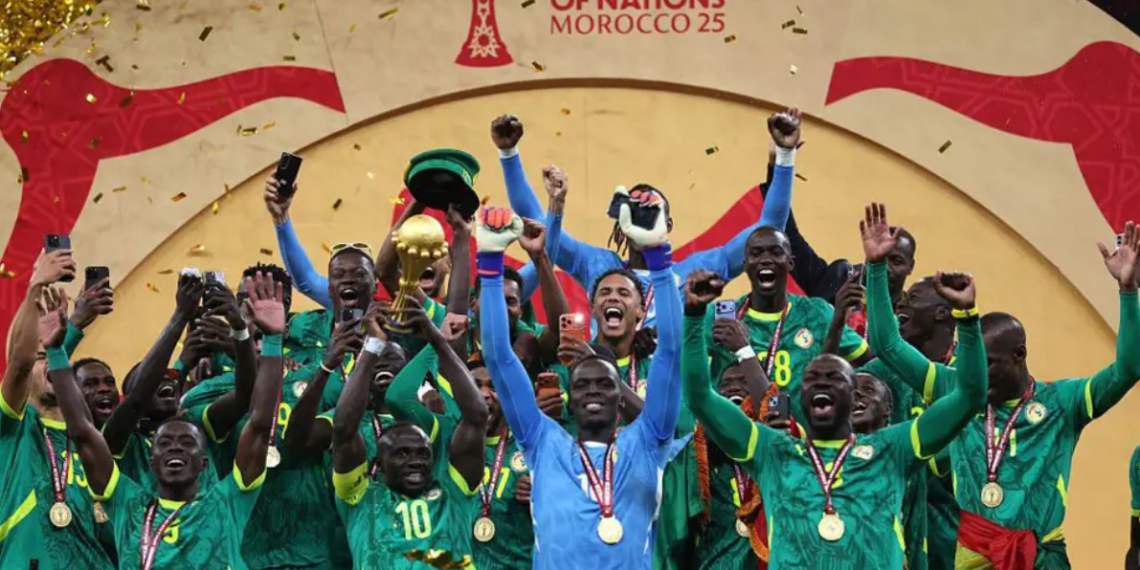
Two months ago, Senegal were celebrating their AFCON triumph. Today, they find themselves stripped of that title.
The Confederation of African Football (CAF), the continent’s football governing body, has reassigned the trophy to Morocco after ruling the final a 3–0 forfeit. The decision has sparked widespread outrage across the football world.
But a key question remains: did CAF actually apply its own rules correctly? A closer look suggests the answer may not be so straightforward.
What happened during the final?
Late in normal time, Morocco were awarded a penalty following a VAR review. Angered by the decision, several Senegal players backed by their head coach walked off the pitch, causing a suspension of about 14 minutes. Crucially, Sadio Mané stepped in, persuaded his teammates to return, and the match resumed.
Morocco failed to convert the penalty, the game moved into extra time, and Senegal secured a 1–0 victory. The full duration of the match was played, the referee restarted proceedings, and the game reached its natural conclusion.
So why the forfeit?
CAF relied on Articles 82 and 84 of AFCON regulations, which state that a team forfeits a match if it leaves the pitch before the end without the referee’s consent, awarding the opponent a 3–0 win. CAF argues this is exactly what Senegal did.
However, this interpretation raises several legal concerns.
The referee’s authority is final
Under the Laws of the Game governed by International Football Association Board (IFAB), the referee has ultimate authority on the pitch. He determines when play stops and resumes, and his factual decisions are final and binding (Law 5.2, “Decisions of the referee”).
In this case, the referee chose to restart the match rather than declare a forfeit. That decision effectively legitimised everything that followed: the missed penalty, extra time, and Senegal’s winning goal.
By overturning the result two months later, CAF’s Appeal Board appears to have retroactively overruled the referee’s authority an action that raises serious legal questions within football governance.
Morocco’s participation complicates matters
Another overlooked issue is Morocco’s own role. When play resumed, they had the option to refuse continuation and file an immediate protest. Instead, they returned to the pitch, with Brahim Diaz stepping up to take the penalty. They continued through extra time, actively attempting to win the match.
This introduces the legal principle of volenti non fit injuria meaning one cannot claim harm from a situation they willingly accepted.
By participating, Morocco arguably consented to the continuation of the match, making their later appeal both legally and morally inconsistent. This point is expected to be central if the case reaches the Court of Arbitration for Sport (CAS).
Was the correct rule applied?
There is also debate over whether CAF applied the right regulation. Article 82 is generally intended for situations where a team abandons a match entirely. In this case, Senegal left temporarily but returned under the referee’s authority, and the match was completed.
Timing is another concern. AFCON rules suggest that if no formal protest is filed within 48 hours, the result becomes final. That deadline passed, confirming Senegal’s 1–0 win—yet CAF later reversed it.
What should have been done?
Historically, similar incidents in football have resulted in fines, suspensions, or disciplinary actions not the reversal of a completed final. This decision marks a rare instance where a tournament winner is determined after the fact by a governing body, rather than on the pitch.
There is no clear rule explicitly allowing a title to be withdrawn after it has been awarded, medals distributed, and the match officially concluded. Many argue that proportionate punishment—not rewriting the result—would have been more appropriate.
What happens next?
Senegal have rejected the ruling and are expected to challenge it, likely at CAS. Their case is expected to focus on several key arguments: the referee’s authority was overridden, the wrong regulation was applied, Morocco consented to the resumed match, and the punishment is disproportionate.
The secretary general of the Senegalese federation summed up their stance bluntly: “The law is on our side. This decision is a travesty.”
Strong words but from a legal standpoint, they may carry weight. The battle over the 2025 AFCON title now appears set to move from the pitch to the courtroom, and the final outcome remains uncertain.