
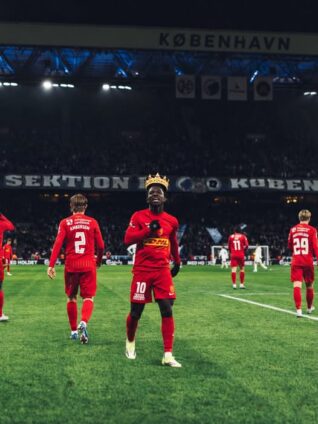
Prince Amoako Jnr has seen the global attention and spotlight in his first senior debut season as a professional footballer.
A feat not all football players or legends dreamed of, the 19-year-old fast, pacy winger is the talk in Denmark as they have named him ‘The Dribbling King’.
Due to his explosive performance this season with 9 goals and 6 assists in all competitions, he has caught the long eye of the Ghana senior national team head coach, who has called Prince for this month’s friendly against Mexico.
This article contains the details of how Prince rose from a kid with a dream from Abease, Amasaman, Ghana, to living the dream in Farum, Denmark.
Just over seven minutes had been played in our home match against FCM in mid-September when our high press led to a ball recovery in Midtjylland’s half.
Caleb Yirenkyi ended up with the ball and passed it on to Alexander Lind, who quickly played it forward to an unmarked Prince Amoako Junior, who immediately headed toward the box.
Mads Bech managed to get across in front of him, but with a quick change of feet, Prince Junior cut inside him and then went past Kevin Mbabu before finding himself so free that he could fire a low shot from 10 metres out. And that was the goal that would later prove to be the only one of the match.
So Prince Junior became the match-winner, and although he was a little fortunate to get the ball past Mbabu as well, the sequence still confirmed the assumption that a new, talented dribbler had emerged on the left wing in Farum. And since then, the season has only reinforced that belief.
After 30 league rounds, Prince Junior tops the Superliga rankings for successful dribbles with no fewer than 65, followed by FC Midtjylland’s Dario Osorio with 61 and Randers’ Elies Mahmoud with 59, while Midtjylland’s Aral Simsir has 52 and AGF’s Gift Links and Viborg’s Sami Jalal share fifth place with 51 successful dribbles each.

So the young Prince has proven himself to be the Superliga’s dribbling king in his very first season in Denmark’s top division — but how did he become so good at it?
“It’s always something I’ve practised, so it’s something I’ve learnt, but I also think it comes naturally because of my background. When people think about African players, they think about flair and players who can entertain, and since I come from Ghana, it feels completely natural.
There are so many Ghanaian players known for doing special things and playing entertaining football,” says the 19-year-old Prince before continuing:
“I started out playing football in the streets, because that’s how football begins for almost every African player. There aren’t many clubs and pitches, so you play in the streets. That’s where you start developing a feel for the ball and learn how to dribble and take players on.
“That’s what I did too, and I really loved it. Then I kept going when I first joined a local team and later became part of Right to Dream when I turned 10.
“I’ve always loved dribbling and taking players on, so it’s something I’ve constantly developed. Of course I know defensive work is important too, but I definitely enjoy dribbling and challenging defenders the most. I love it, and then it’s all about having the confidence to keep doing it even when it doesn’t always work out. That’s how you improve.
“Of course there can be different coaches who criticise you for not passing the ball, and it’s always about finding the right balance in your game. When should you dribble, and when should you pass? I think I’ve become better at that, but I also know I still have more to improve.
Because I believe in myself, and I believe in my dribbling. You have to believe you can do it and then just go for it. And that’s what I do,” says Prince with a big smile.
So he has practised, trained, and thought a lot about different dribbles — and of course he has also found inspiration from some of the very best through YouTube videos.
“I watch Messi a lot because he could do some crazy dribbles. Nowadays I also watch Vinicius Junior because I think we’re a bit similar in playing style. So I study them and what they can do, and then I try it myself. Of course I can’t do it as well as they can, but I practise, and that’s the first step toward getting better,” says the Right to Dream talent, who did not rely only on YouTube videos back then.
Because when he became part of the academy in Ghana, there were constant sources of inspiration all around him.
“Yes, definitely. You can be amazed by Vinicius Junior when you watch him on TV, but that feels far away, whereas I could actually stand there and watch Kudus and Kamaldeen in real life. I saw them. And when I looked at them, I got the feeling that my own dreams could come true too.
“So in that way they really helped me a lot. Watching them made me love football even more, and the fact that they played and dribbled right in front of me, on the same pitch where I trained myself, made it feel like more than just a dream. It felt realistic.
“Kamaldeen… what a player. But the others too. Kudus, Ernest, Simon. It was incredible,” says Prince, smiling again at the thought of the many talented predecessors who went from Right to Dream to FC Nordsjælland.
But every dribbler has his own style and his own weapons, so what exactly does Prince do that has made him the best dribbler in the Superliga this season?
“I’m good at changing direction. I have quick movements and quick feet, and I’m generally pretty fast. I’m not the fastest, but I can accelerate well, and that helps me too. But in the first two or three steps, I’m really quick, and those steps are the most important when you’re a dribbler. Then you don’t need the long runs in the same way.
“If you get free with those first couple of steps, then the defender is gone, and it’s hard for him to catch you again. So the first few steps are the most important thing for me because I play on the wing and need to be able to challenge defenders,” explains Prince, although the season’s statistics do not really support his claim that he is not among the fastest over longer distances.
In fact, he is the fastest player at FCN, as seen, for example, in Parken when he sprinted 66 meters alone and scored the winning goal for 2–1.
But it is his footwork that he primarily focuses on, and he also has the advantage of being able to go both ways around a defender.
“It’s important that you can do both, because if you do the same thing every time, it becomes too easy for the defender. So I’ve trained a lot to be able to go either way around defenders, and now I’ve got it down, so I don’t just have one dribble; I have several options,” says Prince, naming the stepover as his favourite move. There’s also “The Snake”, although he cannot remember using it in a match yet.
And in the most recent match against Brøndby, it was mostly the nutmegs people noticed.
“That has been my favourite match so far, and not only because I scored, but also because I had a lot of good moments in one-on-one duels. It’s always a good sign when your direct opponent gets substituted at halftime.
“It’s true that I don’t usually make as many nutmegs as I did there, but you play according to the situation. That’s one of the most important things when you’re a dribbler. You play according to what appears in front of you, and then it’s about finding the best solution to what you see,” says Prince, pointing to Viborg’s Hjalte Bidstrup as one of the full-backs he has found harder to beat.
But with 65 successful dribbles this season, things have generally gone very well, and Prince is happy about that because he loves dribbling and taking players on.
“For me, it’s fun. It’s what I base my game on, and it’s the way I want to help my team. If I’ve had a bad day dribbling but still scored a goal, I’m still not completely satisfied because dribbling means so much to me. That’s what I want to be good at; that’s what I want to be known for. My dribbling,” says Prince near the end of his first completed Superliga season.
It has produced 29 matches, eight goals, five assists, and 65 successful dribbles – so how has it all been?
“I actually think it’s been difficult. People really don’t realise how tough the Superliga is. It takes time to adapt, and you shouldn’t expect to come in and become a superstar immediately. Every team is good, and the defenders are very big and strong.
“So it’s been difficult, but also memorable. I’ve learned an incredible amount from the coaching staff, and I’ve been part of a really good team that has helped me become good at the things I’m good at.
“And I think I can be proud of the season I’ve had, considering it’s my first as a senior player. I’m happy with how things have gone and with how well we’ve performed as a team, but I also know I can do so much more,” says Prince before the season’s sixth meeting with FC Midtjylland.
Both matches at Right to Dream Park have been won — first in the league and then in the cup — and Prince has scored in both, so what does he think about the challenge ahead?
“It’s one of the best teams in the Superliga, so we know it will be a big challenge. Especially because they’re difficult to play against with this man-to-man marking. You always have an opponent right on your back, and it’s always some big, strong guy, so it’s very physical and difficult.
“But I’ve scored against them twice here at Right to Dream Park, so I don’t know what would stop me from doing it again. I definitely hope we win, and it would be fantastic if I could score against them again. And of course I also hope I can help my teammates with a lot of successful dribbles,” says dribbling king Prince Amoako Junior.