
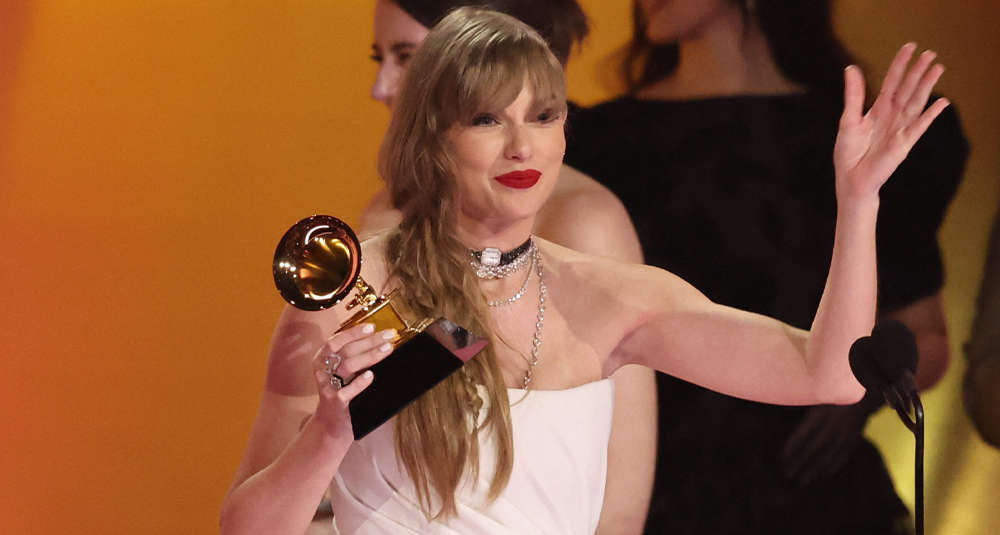
When the nominees for the 68th Annual Grammy Awards were announced, two big names — Taylor Swift and Ghana’s Shatta Wale — were notably missing.
Their absence sparked reactions across social media, with fans questioning why two of the most recognized figures in their respective industries failed to secure a spot. The reasons, however, are clear and tied to the Grammy Awards’ strict eligibility and voting process.
Taylor Swift: Missed the Eligibility Window
Taylor Swift’s latest studio album, The Life of a Showgirl, was released on October 3, 2025, which is outside the Grammy Awards’ eligibility window.
The Recording Academy’s eligibility period for the 2026 Grammys ran from August 31, 2024, to August 30, 2025. Since Taylor’s album came out after the deadline, it will not be considered until the 2027 Grammy Awards.

In addition to this, Taylor did not release any other singles, collaborations, or projects during the qualifying period, leaving her with no eligible work to be submitted. Therefore, her absence from the nominations list was not a snub but a matter of timing. Fans can expect her to make a strong return next year when The Life of a Showgirl officially qualifies for consideration.
Shatta Wale: Submitted But Not Nominated
Unlike Taylor Swift, Ghanaian dancehall superstar Shatta Wale did submit his work for Grammy consideration.
His single Street Crown was entered for the “Best African Music Performance” category. Despite meeting the eligibility requirements, the song did not make it to the final nomination list.

This outcome is not unusual. Submission for Grammy consideration is just the first step in a competitive multi-phase process. After screening, only the most-voted entries advance to official nominations.
In categories such as “Best African Music Performance,” competition is particularly fierce, with heavyweights like Burna Boy, Tyla, Ayra Starr, and Davido also vying for recognition.
Shatta Wale’s exclusion does not mean his music lacked quality. Instead, it highlights how competitive the field has become as African music continues to rise globally. The selection process involves thousands of academy voters, and only a few entries make it through to the final nomination list.
Understanding the Grammy Rules
To qualify for the 2026 Grammy Awards, songs or albums must have been released between August 31, 2024, and August 30, 2025. Works released even a day later are automatically pushed to the following year’s awards.
After submission, the Recording Academy screens all entries to ensure they fit into their respective categories. The final nominees are determined by voting members who are professionals within the music industry.
These strict rules mean that even globally celebrated artists are not exempt from timing issues or the competitive voting system. Success at the Grammys depends as much on timing and campaigning as it does on musical quality.
What This Means for Both Artists
For Taylor Swift, this is a temporary break in her long Grammy-winning streak. With 14 Grammys to her name and decades of consistent nominations, she remains one of the most dominant artists in Grammy history. Her fans can look forward to seeing her back in contention in 2027 with The Life of a Showgirl.
For Shatta Wale, this experience provides insight into how the Grammy system works and what can be improved for future submissions.
As African music gains more visibility globally, Ghanaian artists like Shatta Wale, Black Sherif, and Stonebwoy are poised to make stronger showings in upcoming Grammy cycles. The competition is tough, but Ghana’s growing musical influence cannot be ignored.
Taylor Swift and Shatta Wale’s absence from the 2026 Grammy nominations stems not from a lack of artistry, but from timing and process.
Taylor’s album missed the eligibility window, while Shatta Wale’s entry didn’t secure enough votes in an increasingly competitive category.
Both remain major forces in their genres and are expected to bounce back stronger in the next Grammy cycle.
As the 2026 Grammys draw near, their fans will be watching closely — not for what was missed, but for what’s to come next year when both stars are likely to return to the global stage.