

For the first time since the FIFA World Rankings were introduced, the top four ranked men’s national teams have all advanced to the semi-finals of a FIFA World Cup.
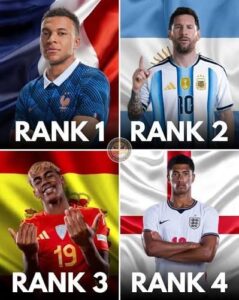
World number one Spain, second-ranked Argentina, third-ranked France, and fourth-ranked England have each booked their place in the last four of the 2026 tournament, helped in part by a revised draw format introduced by FIFA.
Under the new system, the four highest-ranked teams were placed in separate sections of the knockout bracket, ensuring they could not face one another before the semi-finals. To benefit from this arrangement, however, each team first had to finish top of its group—a feat all four successfully achieved.
As a result, Spain and Argentina were kept apart until a potential final, while England and France were placed on opposite sides of the knockout draw.
This created the possibility of France facing Spain and England meeting Argentina in the semi-finals, which is exactly how the fixtures have unfolded.
FIFA said the revised format was designed to promote “competitive balance” by creating two distinct routes to the semi-finals.
The semi-final line-up now sees France take on Spain on Tuesday, while England will face Argentina on Wednesday.
The approach is similar to the seeding systems used in competitions such as Wimbledon and the UEFA Champions League, where top-ranked competitors are deliberately separated to prevent early clashes.
Although the FIFA World Rankings were introduced in 1994, they were not used to determine that year’s World Cup draw. In previous tournaments, highly ranked teams have often fallen short of expectations.
Belgium (2022), Germany (2018), Spain (2014), Italy (2010), and France (2002) were all ranked among the world’s top four but failed to progress beyond the group stage.
Since the 1998 World Cup, there had never been a tournament in which all four of the highest-ranked nations reached the semi-finals.
FIFA Adjusted the Draw for the Expanded Tournament
FIFA openly explained the reasoning behind the new draw process before the tournament began, stating that it wanted to prevent the highest-ranked teams from eliminating one another too early in the knockout rounds and preserve the possibility of high-profile matches in the latter stages of the competition.
Under the previous 32-team format, group winners could not meet in the Round of 16, making early clashes between elite teams relatively uncommon. The last time two of the world’s top four ranked nations met before the semi-finals was in 2010, when the Netherlands defeated Brazil 2-1 in the quarter-finals.
The expansion to a 48-team World Cup introduced an additional knockout round, significantly increasing the likelihood of group winners meeting earlier in the tournament.
During the 2026 Round of 32, several such matchups occurred, including United States versus Belgium, England against Mexico, and Switzerland taking on Colombia.
To avoid losing one of the tournament’s biggest attractions too soon, FIFA modified the knockout bracket to keep the four highest-ranked teams apart until the semi-finals whenever possible.
A similar seeding model was also used at last year’s FIFA Club World Cup. In the 2026 World Cup, however, the strategy has delivered exactly what FIFA had envisioned, with the world’s four highest-ranked nations all progressing to the final four.