

Ashanti Regional Chairman of the New Patriotic Party (NPP), Bernard Antwi Boasiako, popularly known as Chairman Wontumi, has filed an application at the High Court seeking bail while his appeal against his conviction is being considered.
The application, submitted on August 5, 2026, states that Wontumi, the first appellant in the case, is currently serving his sentence at the Nsawam Medium Security Prisons.
Filed by his lawyer, Samuel Atta Akyea of Zoe, Akyea & Co., the motion is brought under Section 96(1) of the Criminal and Other Offences (Procedure) Act, 1960 (Act 30) and Section 33(1) of the Courts Act, 1993 (Act 459).
Through the application, Wontumi is asking the court to grant him bail pending the hearing and final determination of his appeal, relying on the grounds outlined in a supporting affidavit.
The case, titled The Republic v. Bernard Antwi Boasiako @ Wontumi, Kwame Antwi (at large), and Akonta Mining Company Limited, identifies Wontumi as the first appellant/applicant, while Akonta Mining Company Limited is listed as the third appellant.
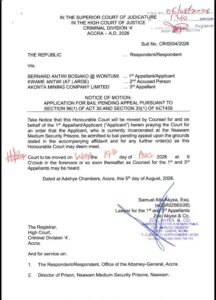
The High Court’s Criminal Division “4” in Accra is expected to hear the bail application on August 19, 2026.
Copies of the application have been served on the Office of the Attorney-General, which is the respondent in the case, as well as the Director of the Nsawam Medium Security Prisons.
The court will decide whether Wontumi should be released on bail while his appeal against the conviction is pending.
Chairman Wontumi was sentenced to 20 years’ imprisonment after the High Court’s Criminal Court 4 found him guilty on all six charges brought against him.
He was convicted alongside Akonta Mining Company Limited, while a third accused person, Kwame Antwi, remains at large.
The prosecution accused the defendants of engaging in illegal mining activities on Akonta Mining Company’s concession at Samreboi in the Western Region.
According to prosecutors, the accused unlawfully transferred mineral rights on the concession without obtaining the approval of the sector minister and facilitated mining operations without the required legal authorisation, contrary to the provisions of the Minerals and Mining Act.