
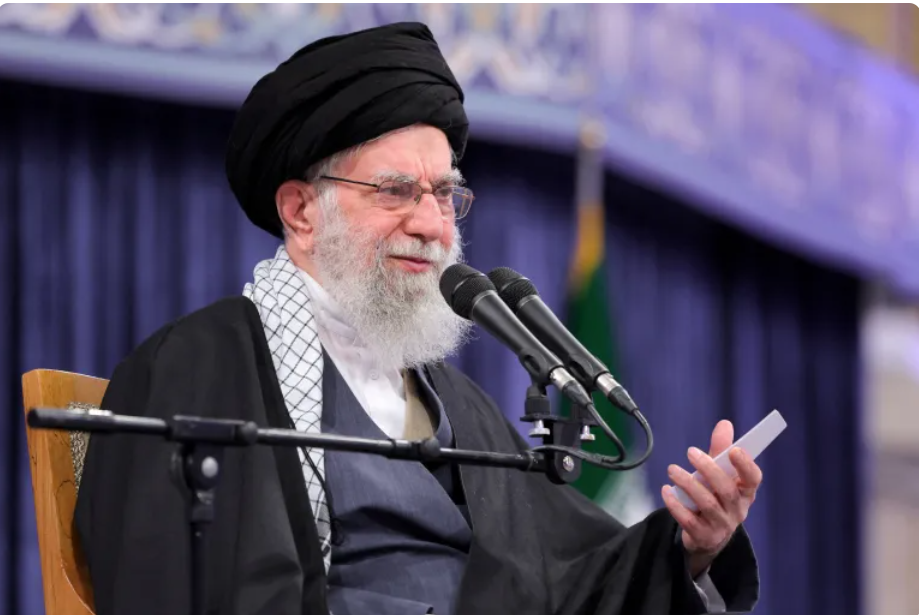
Iran’s state media have confirmed the death of Ayatollah Ali Khamenei, who was reportedly killed at his office during coordinated US-Israeli airstrikes on Iran.
The announcement follows earlier claims by American and Israeli officials that the Iranian Supreme Leader had been eliminated in the attacks.
Authorities in Tehran have declared a 40-day national mourning period for the 86-year-old leader, who had ruled the country since 1989. The confirmation on Sunday contrasts with earlier reports by Iran’s Tasnim and Mehr news agencies, which had maintained that Khamenei remained “steadfast and firm in commanding the field.”
US President Donald Trump stated earlier on his Truth Social platform that Khamenei was killed in joint strikes that began early Saturday. Trump claimed the operation relied on advanced intelligence and tracking systems coordinated with Israel.
He described the development as an opportunity for the Iranian people to reclaim their country and expressed hope that the Islamic Revolutionary Guard Corps (IRGC) and police would align peacefully with what he termed “Iranian Patriots.”
Although Iranian officials had reportedly prepared contingency plans in the event of Khamenei’s death during a conflict with the US or Israel, his assassination adds significant uncertainty to an already volatile situation. Analysts warn that the development could intensify hostilities and widen the scope of the confrontation.
Israeli Prime Minister Benjamin Netanyahu had earlier indicated there were “growing signs” that Khamenei had been killed. Meanwhile, Reuters, citing a senior Israeli official, reported that the leader’s body had been located.
Khamenei became Iran’s Supreme Leader in 1989, succeeding Ayatollah Ruhollah Khomeini, the architect of the 1979 Islamic Revolution.
As Supreme Leader, he exercised ultimate authority over the executive, legislative and judicial branches, commanded the armed forces, and served as the country’s highest religious authority.
Barbara Slavin, a distinguished fellow at the Stimson Center in Washington, DC, told Al Jazeera that Iran likely has mechanisms in place to manage the transition. She suggested a governing council could assume control, adding that such a body may already have been operating behind the scenes.
The strikes on Saturday reportedly targeted 24 provinces across Iran, killing at least 201 people, according to Iranian media citing the Red Crescent. Among the casualties were civilians, including students.
Israeli air raids hit two schools, including the Shajareh Tayyebeh girls’ elementary school in the southern city of Minab, where at least 108 people were reported killed. Additional fatalities were reported at a school east of Tehran.
Netanyahu said the military campaign had “eliminated” numerous senior figures, including commanders within the IRGC and officials linked to Iran’s nuclear programme. He pledged that operations would continue.
Trump also signaled that what he described as “heavy and pinpoint bombing” would persist throughout the week or for as long as deemed necessary.
In response, Iran launched counterattacks on Saturday, prompting air-defense interceptions in countries hosting US military assets, including Kuwait, Qatar, the United Arab Emirates and Bahrain.
The IRGC later announced that third and fourth waves of retaliatory strikes against US and Israeli positions were underway, according to Iran’s IRNA news agency.
At an emergency session of the United Nations Security Council, Secretary-General Antonio Guterres expressed regret that diplomatic efforts had failed.
He warned that continued military action risked triggering uncontrollable consequences in one of the world’s most unstable regions and called for immediate de-escalation.
Iran’s ambassador to the UN, Amir Saeid Iravani, accused the US and Israel of launching what he described as an unprovoked and deliberate act of aggression targeting densely populated civilian areas. He labeled the attacks a war crime and a crime against humanity.
The US ambassador to the UN, Mike Waltz, defended the operation as lawful, arguing that preventing Iran from acquiring nuclear weapons was a matter of global security rather than politics.
China’s UN envoy, Fu Cong, voiced serious concern over the rapid escalation of regional tensions, while Russia’s ambassador, Vassily Nebenzia, condemned the strikes and urged Washington and Tel Aviv to halt what he called aggressive actions immediately.
Source: Al Jazeera