

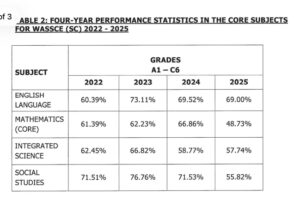
The release of the 2025 West African Senior School Certificate Examination (WASSCE) results has ignited widespread debate across Ghana, as the country grapples with what many analysts describe as one of the most disappointing outcomes in recent years.
With a sharp decline in passes across core subjects particularly Mathematics, Integrated Science, and English Language the nation is now asking the critical question: Who is to blame for the massive failure? Is it the students, the teachers, or the government?
Education stakeholders, parents, teachers’ unions, and political commentators have all voiced strong opinions, underscoring the complexity of the issue.
A closer look reveals that the problem is multi-dimensional, rooted in systemic gaps, declining discipline, inadequate resources, and evolving learning patterns among students.
Students: A Cultural Shift in Learning Habits
One of the most frequently cited causes of the poor performance is the changing behaviour and learning habits of students. Many educators argue that students have become increasingly dependent on social media, shortcuts, and last-minute preparations.
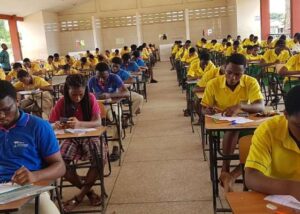
Several teachers who supervised the 2025 examination describe a worrying trend: a growing number of students rely on leaked questions, exam “apor,” and online rumours instead of serious study. When the anticipated leak fails, their performance collapses.
Moreover, the widespread use of smartphones has affected concentration levels. Schools report that many students spend more time on TikTok, Facebook Reels, and mobile games than on revision. This digital distraction has contributed to lower retention, weak analytical skills, and shallow understanding of core concepts.
Counsellors also point to the rising issue of exam anxiety and mental health challenges among senior high students. The pressure to excel, especially in competitive programmes like Science and Business, leads many to burn out before the examination.
Still, others argue that despite the distractions, motivated students continue to perform well suggesting that students alone cannot be blamed for the decline.
Teachers: Overburdened, Under-resourced, and Under Pressure
The role of teachers in the WASSCE 2025 performance has also come under scrutiny. While many educators work tirelessly under difficult conditions, teacher effectiveness has dipped in several schools due to increased workload and poor motivation.
Some teachers report overcrowded classrooms, sometimes with more than 70 students per class, making personalised teaching nearly impossible. Practical lessons in Science and ICT are often replaced with theory because many schools lack functioning laboratories or computers.
Others point to inadequate supervision in certain schools, leading to inconsistent lesson delivery. Inexperienced teachers posted to rural schools struggle without proper guidance, and professional development programmes have not been regular enough to keep educators updated with modern teaching techniques.
Teacher unions have also argued that delays in allowances, promotion bottlenecks, and lack of teaching and learning materials weaken motivation. Without proper support, even the best teachers struggle to deliver quality education.
However, critics insist that some teachers have fallen behind, failing to adapt to new teaching styles or integrate technology into the classroom.
Government: Policies With Good Intentions but Poor Execution
A significant portion of the debate places responsibility on government policy particularly the Free Senior High School (Free SHS) programme and the double-track system, which many believe continue to affect learning outcomes.
Education experts note that while Free SHS has expanded access, it has also stretched existing infrastructure. Many schools continue to deal with limited resources despite increased enrolment. Dormitories, classrooms, and laboratories are overstretched, affecting both teaching and learning.
The government’s rollout of tablets and digital learning tools for students, though innovative, has faced criticism.
Reports from Parliament and the Ministry of Education indicate that thousands of the devices are not fully customised or are being misused for entertainment rather than academic purposes.
Additionally, irregular supply of textbooks especially the new standard-based curriculum materials has affected the preparedness of students entering SHS.
Funding delays, logistical challenges, and inconsistent monitoring have further hampered the effective implementation of education initiatives. Some argue that policymakers focus more on political messaging than long-term structural reforms.
A Shared Responsibility
While the debate continues, most experts agree that the massive WASSCE 2025 failure cannot be pinned on a single group. Instead, the results reflect a combination of student attitudes, teacher challenges, systemic weaknesses, and policy shortcomings.
Students must cultivate better study habits, discipline, and responsibility.
Teachers need more support, resources, and training to improve delivery.
Government must strengthen educational infrastructure, provide adequate teaching materials, and ensure effective implementation of reforms.
The Way Forward
To prevent a repeat of the 2025 outcome, stakeholders are calling for urgent interventions, including:
A nationwide review of the Free SHS programme to address structural gaps.
Investment in laboratories, libraries, and digital monitoring of school resources.
Reintroduction of rigorous supervision and teacher appraisal.
Guidance and counselling units to focus on mental health and academic planning.
Stronger collaboration between parents and teachers in monitoring student behaviour.
A national campaign against exam malpractice and exam leaks.
The 2025 WASSCE results serve as a wake-up call. Ghana’s education system is at a crossroads, and unless swift and collective action is taken, the nation risks further decline in academic standards. The responsibility lies with every stakeholder—students, teachers, government, and society as a whole—to rebuild the foundation of quality education.